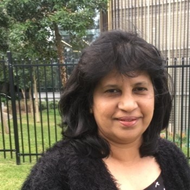
Established in 1998, the Apra Margaret Fuhry Award is given to an Apra member committed to the prospect development (PD) profession, based on leadership, mentorship, and volunteerism. The 2025 recipient was Eresha De Silva, head of donor operations on World Vision Australia’s private funding team.
What follows is an email conversation between fellow Fuhry awardee Jeff Walker (2004) and De Silva. Learn how she entered the profession, what keeps her inspired, her advice for those new to the PD community, and more.
What path did you follow into our profession and into your role at World Vision Australia?
I have spent more than 16 years in PD. I began with a degree in information science from Leeds Beckett University in the UK and progressed to a career in IT. My move into philanthropy began at Macquarie University of Sydney, Australia. I was hired to implement and enhance the CRM, which was my area of expertise then, for the Advancement department. I was also asked to build the PD operation from scratch. It was a rewarding experience that had a significant impact on the university’s fundraising for student scholarships, research, and its teaching hospital.
Last year, I was given the wonderful opportunity to join World Vision Australia’s talented Private Funding (Major Gifts) leadership team. My role as head of donor operations includes being responsible for PD and data insights, as well as implementing and enhancing the CRM for Private Funding. It is such a privilege to use PD and data-driven strategies to assist the philanthropy team. We raise much-needed funds that improve the lives of vulnerable children and families around the world.
You’ve mentioned your “deep passion for purpose-driven work” and the “analytical rigor” and “cross-industry and global perspective” you bring to it. What’s the origin story behind that passion and perspective?
I have always been driven to do work that creates meaningful impact. While my IT career contributed in many valuable ways, PD combines my research strengths with the analytical mindset shaped by my science background and allows me to support big philanthropic goals.
I have worked across multiple industries and lived in several countries. My father’s UN career meant frequent moves! I have a Sri Lankan heritage and have lived in Australia for many years. I have also conducted research and built prospect portfolios for many international projects. This varied experience gives me a truly global, cross-industry perspective.
How did you learn you had been selected for the Fuhry Award? What was your first reaction?
I learned I had been selected through an email from Apra. I had to read it a few times, because it seemed unbelievable. I think I emailed back and reconfirmed it, just to be sure. It was only the second time this award has been given to an Australian researcher.
How has the grant helped you?
Receiving the award was incredibly humbling, and the funding was truly wonderful. It meant I could attend Apra PD 2025 in Baltimore, an event in which I had been eager to participate. I was fortunate to attend the Apra conference several years ago and found it to be exceptionally valuable and memorable. Although I was keen to go again, recent budget constraints made it challenging, especially with the cost of traveling from Australia and other associated expenses.
The funding made what felt out of reach possible, and the 2025 conference was once again an exceptional experience. I am deeply grateful to Apra.
What does the Apra community mean to you? Do you have any favorite stories about your leadership, volunteering, presenting, or mentoring?
Although I am based in Australia, Apra International has been a vital catalyst in my PD career. When I first joined, the profession was still emerging here, and Apra’s knowledge resources and global network played a significant role in shaping my path. Attending my first Apra conference in Pittsburgh in 2018 was an unforgettable experience.
I was fortunate to serve on the founding committee of Apra Australia. It’s remarkable to think that, just a decade ago, it did not exist. Today, it stands as a cornerstone of our profession Down Under.
One of my standout memories was hosting the final Prospect Research Conference at Macquarie University in 2016, just before it officially became the Apra Australia Conference. It was only the third time the event had been held, and my team rose to the challenge. We introduced international speakers from the US, the UK, and Asia for the very first time (both in person and via Zoom), which elevated the conference to a new level. Since then, I have presented at the conference several times.
I’ve also had the privilege of participating in the Apra Australia mentoring program for more than five years. It has been deeply rewarding. I’ve learned so much from my mentees, and I hope they have taken something valuable from me as well. Along the way, I’ve built friendships that I know will last.
Professional and personal growth doesn’t happen in isolation. Apra creates the space to connect, learn, and contribute. I believe we all share a responsibility to help shape and strengthen our industry. For me, Apra is where that work begins.
What career accomplishments are you most proud of, and why?
Organizing the 2016 Prospect Research Conference in Sydney, with international speakers for the first time; being part of the committee that established Apra Australia; and developing the PD function while supporting a 10year campaign at Macquarie University are accomplishments I look back on with real pride. Each was a first-of-its-kind effort. I’m equally proud of my mentoring, both formally through Apra Australia and informally within the profession. Helping develop team members and emerging practitioners has been one of the most rewarding aspects of my career. It strengthens our field, builds new expertise, and keeps the profession growing. Of course, receiving the Fuhry Award was wonderful, since it paved the way for me to attend Apra PD 2025.
What advice would you offer for new or recent members of the Apra community?
While we have an impressive array of tools and techniques at our fingertips, it’s worth remembering that our most powerful resource is often the people around us: our colleagues, our networks, and our broader professional community. That’s what makes Apra invaluable. Beyond the wealth of knowledge it offers, Apra connects us with generous, insightful professionals across the industry. They elevate our work and expand our perspective.
Look ahead 10 years. How do you think PD will have changed?
It’s clear that AI is driving a shift toward greater automation, especially in PD. Many institutions already use AI-powered tools for tasks like preliminary initial due diligence and individual giving campaigns. But researchers won’t become obsolete. We simply need to adapt. Every technological leap creates similar concerns, yet people always remain essential.
Beyond AI, PD is gaining momentum and expanding globally. Although PD was established in higher education, more and more nonprofits in other sectors are recognising its value. Intelligence roles have long existed in police and defence work. Now, we’re seeing that same strategic approach applied to fundraising and sales.
PD has come so far in the last decade. This is particularly apparent in Australia. The diversity of topics at Apra PD 2025 showed how essential our profession is becoming across industries. In the next ten years, it will progress even further. It’s an exciting time.
What would you say to encourage someone to consider PD as a career?
We’re in a specialised field, where curiosity, strategy, and purpose come together in a powerful way. You get to blend data analysis with relationship insight, to help organisations understand their supporters and make smarter, more meaningful decisions. It’s a profession built on continuous learning, constant evolution, and the excitement of discovery.
Most importantly, PD sits at the heart of fundraising. You may not be the one asking for the gift, but your work fuels the mission. The insights you uncover help drive the programs, research, and initiatives that change lives. It’s a career where your skills genuinely make a difference. That’s something well worth being a part of.
Reminder: Apra award nominations are currently open. If you or someone you know is driving change and making an impact, submit a nomination for an Apra Award by Friday, March 13.

Jeffrey A. Walker, PhD
Senior Strategic Research Officer, Office of Advancement and Alumnae/i Relations, Simmons University
Jeff Walker is the (fully remote) senior strategic research officer for SimmonsUniversity’s Office of Advancement and Alumnae/iRelations and has been a PDprofessional since August 1998. He is also a longtime member of the Apra ContentDevelopment Committee, a former Apra Wisconsin president, and a current advisoryboard member for the Wisconsin chapter