Leadership
The Path to People Management in Prospect Development: Part One
By Lauren Woodring | September 08, 2026
At the PD 2025 conference in Baltimore, I was talking with an Apra friend who told me that they wanted to become a people manager. They didn’t know how to get there because so many job postings require prior management experience. I understood the dilemma. I became a manager in a small shop when my boss left; the role wasn’t posted and I got the promotion because I was the only person who knew the system. I know, however, that this isn’t everyone’s path to management.
That conversation stuck with me: how do prospect development professionals actually move from individual contributors to people managers? As I thought about it, I realized the answer was unlikely to be as straightforward as I expected. With Apra International’s help, I surveyed
current managers, and 70 people responded. In Part 1, I’ll share how respondents became managers and what they manage. In Part 2, I’ll focus on their advice for making the transition.
Education and Certifications
I was curious if formal advanced degrees or certifications obtained before becoming a manager were prevalent in the survey group. Just over half of the 70 managers (51%) have at least one formal degree beyond a bachelor’s degree. Certifications were less common, with only 8 respondents (11%) saying they had at least one before becoming a manager. I was personally surprised that only one person said they had a CFRE certification before becoming a manager. So, while having degrees and certifications could improve one’s chances of becoming a manager, in our field it doesn’t appear to be a necessity.
Takeaway: Before becoming a manager, advanced degrees are common, but certifications are not.
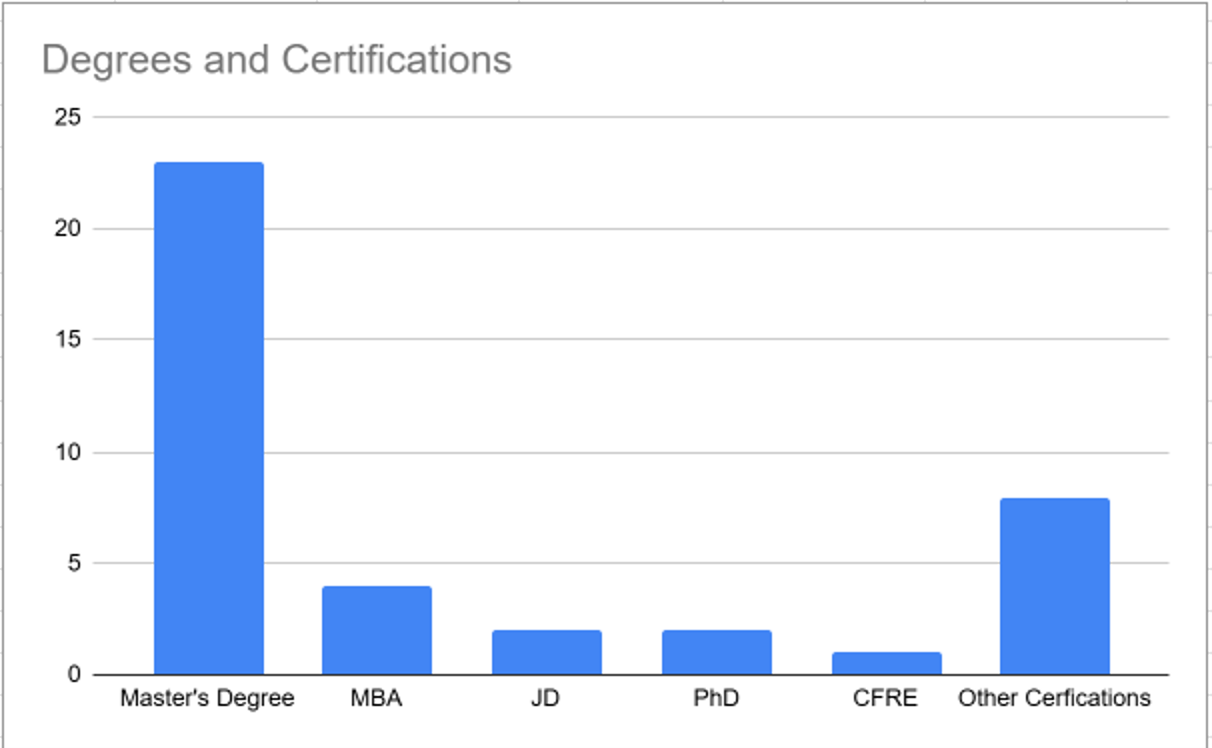
Chart: Advanced degrees and certifications of the 70 survey respondents. Note that some people had more than one degree and/or certification.
Experience
What does seem to matter is experience. The majority (57%) of respondents had 5+ years of prospect development experience. A small group came into managing prospect development with other fundraising experience (4%). The rest (37%) had been in the field for less than five years, with only 1 person saying they got their position with no specific prospect development or other fundraising experience. Some respondents came into their position with other management experience: a few had fundraising management experience outside of prospect development (10%), and several had a management position outside of fundraising altogether (21%). I don’t think it will surprise any of us that experience in the field matters.
Takeaway: Most, but not all, managers have 5+ years of prospect development or other fundraising management experience before becoming a people manager.
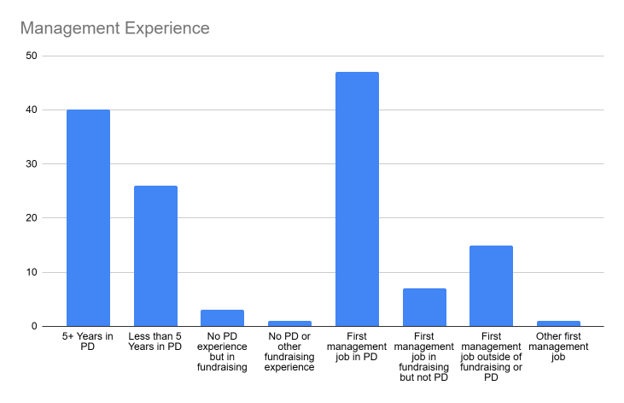
Chart: Experience of current managers both in years and prior management.
How Managers Got Their First Management Job
Our survey respondents shared several ways in which they found their first management job. Some people (37%) took a position at a new institution, including a few people who went back to a former employer. Other people (29%) were promoted to a new position at the organization where they currently worked. Others (29%) matched my experience by being promoted to an open position at their institution. A small group (7%) mentioned that they were given management responsibilities without a promotion. One person sadly even specifically mentioned that for them, this did not include extra compensation.
More than half of respondents (54%) reported stepping into their first management role without formally applying, similar to my own experience. A smaller group (13%) was encouraged to apply for their management position. The rest (33%) applied for the position on their own.
Overall, about ⅔ of people started managing colleagues where they were working at the time. I think this figure explains why my friend was lamenting seeing job postings for management positions that required experience. It seems that many of us are being promoted into management roles without having to leave our institutions, which gives us that experience if we decide we want to look for a new role. However, the ⅓ who moved to a new institution without management experience does show that it is possible!
Takeaway: About ⅔ of prospect development managers started management without moving institutions, while ⅓ changed organizations.
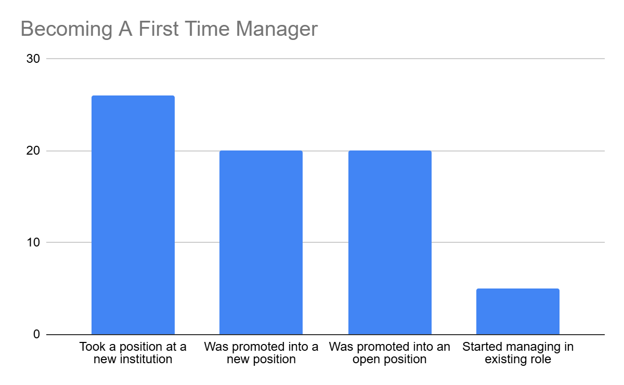
Chart: Type of move a manager made to get their first management job.
Where Are They Now
I was curious about what current positions our respondents hold look like in terms of job titles and the areas they oversee. They have had a wide number of years being a manager, with a small group (7%) having more than 20 years of experience as a manager, while a few (4%) had been managers for less than a year. Job titles varied widely from organization to organization, with the majority (53%) of current managers holding a Director or Senior Director title. Some (10%) have more senior job titles such as Assistant/Associate Vice Presidents or Vice Presidents. One respondent even reported managing staff while holding an analyst title.
Our surveyed managers are overseeing a lot. The majority (70%) have 2-4 direct reports, with several (19%) managing one person and the rest managing 5+. I was surprised that a significant number of our managers (at least 31%) are managing other managers as well.
Many managers oversee several areas of fundraising, with the majority in charge of an area of prospect research (79%), prospect development overall (64%), principal gifts prospect development (29%), data analytics (19%), records/database (19%) and prospect management (13%). Other categories of responsibility include donor relations, digital fundraising, online giving, office administration, marketing, individual giving, corporate & foundation giving and strategy. That is quite a range of possibilities.
Takeaway: Current prospect development managers have a variety of tenure in managing staff; job titles can vary, and while most manage traditional prospect development areas, that can also depend on the position.
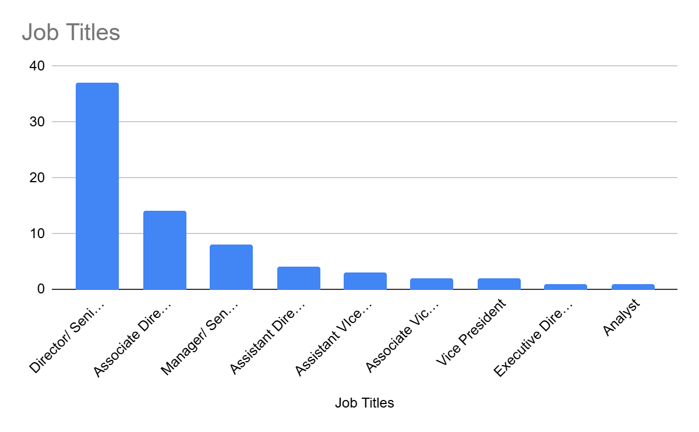
Chart: Job titles our survey respondents currently hold.
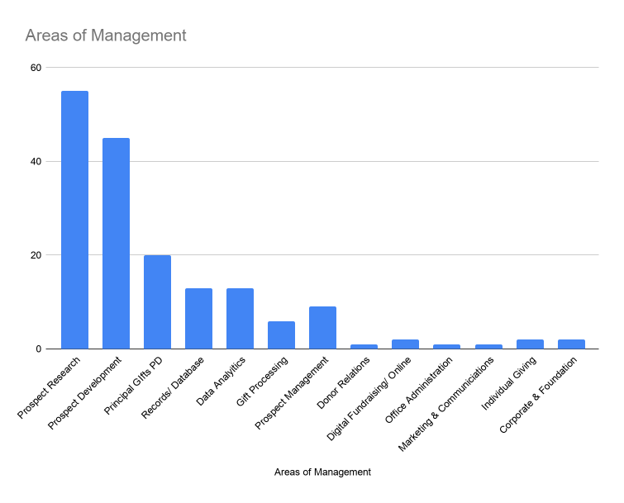
Chart: Work current managers oversee.
What Now?
If you’re reading this article and thinking “that’s interesting, but how do I become a manager?”, I hope you’ll come back for part two, where I’ll share the excellent advice this group gave for transitioning into a management role.
As one last note, I know lots of smart and talented prospect development professionals who have no interest in managing colleagues. Some of them have done it before and intentionally sought new non-management positions, and others just know it isn’t for them. Success in our field can look like many different things; management is just one path!
Survey note: results reflect 70 self-identified current people managers in prospect development (percentages may not total 100% where multiple selections were allowed). While this isn’t a scientific study, it does provide an interesting snapshot of current managers across our profession.

Lauren Woodring
Deputy Director, High Net Worth, Yale University
Lauren Woodring is the Deputy Director, High Net Worth at Yale University. Previously, she held prospect development positions at the Philadelphia Museum of Art and Ensemble Arts Philly. Lauren is a current board member of Apra International and former President of Apra Pennsylvania. She lives in both New Haven, CT and Philadelphia, PA. Outside of work, she enjoys caring too much about Philadelphia sports. Lauren wants to thank the other managers who kindly took the time to take this survey!