Too often, efforts to adopt advanced, emerging-technology tools stall because basic digital skills are missing. In prospect development and advancement analytics, this gap can be large. Many professionals are outstanding at relationship-building, writing and strategy, but have had limited exposure to essential data concepts such as consistent definitions, clean source records and repeatable reporting. When those basics are missing, adopting machine learning or generative AI becomes slow, fragile and hard to quality-control (Data Literacy Project, 2022).
This is a problem across the philanthropic sector, where data availability and quality and related readiness issues repeatedly show up as leading barriers to successful AI implementation. (Gartner, 2025b). Research on AI in production environments similarly points to data quality as a top obstacle to scaling AI beyond experimentation (BARC, 2025). In practice, this is how many organizations end up with “black boxes” that are difficult to align with real goals, explain to stakeholders or improve over time.
In our advancement shop, we believe steady development of digital maturity is a practical path to successful AI projects. Industry data backs this up: in one Gartner survey, high-maturity organizations were more than twice as likely as low-maturity ones to keep AI projects running for three years or more – 45% versus 20% (Gartner, 2025a). Here, we apply the “Digital Skills Gap Fillers” concept, which I introduced in a 2025 working paper (Shchelkov, 2025): a set of tools, prototypes and frameworks that are based on advanced IT ideas but remain accessible to non-technical users with reasonable training and without disrupting their core responsibilities.
These Gap Fillers serve two purposes for non-technical professionals:
- Enhance efficiency by providing tools that help them perform current work more effectively than with traditional methods.
- Teach the basics of complex IT concepts through simplified, hands-on examples (often using no-code or low-code tools) to improve communication with IT teams and external vendors.
Leadership also influences whether this progression feels achievable. Framing Gap Fillers as protected, career-building opportunities—rather than additional tasks placed on already-full workloads—can reduce anxiety and encourage experimentation.
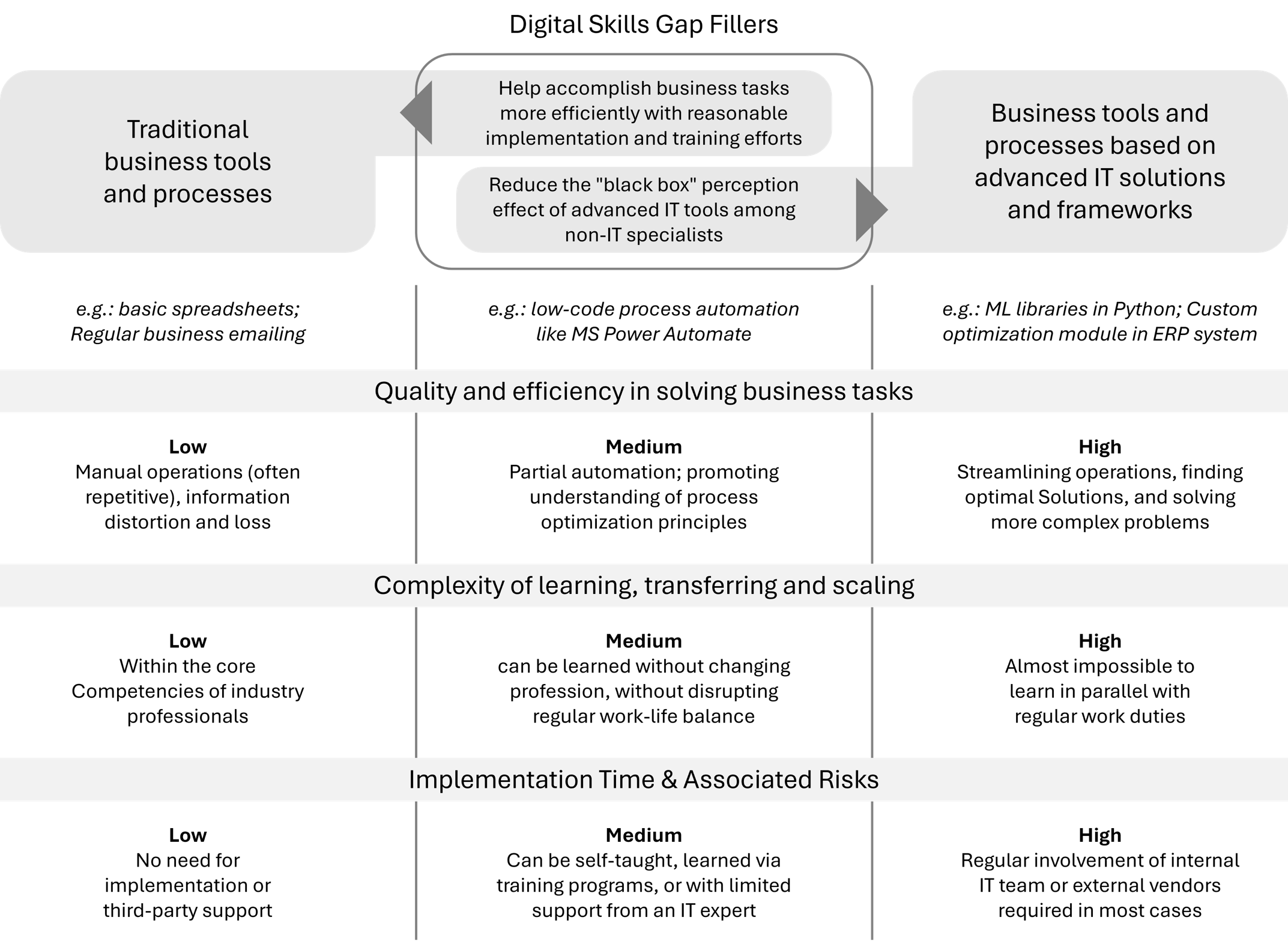
Connections readers work in offices ranging from one-person operations to large philanthropic organizations. Depending on the maturity of an organization’s advancement processes, different tools may serve as “Gap Fillers,” but the idea stays the same: build capability in steps, so each step improves today’s work while preparing staff for tomorrow’s tools. The five examples below are drawn from real-world projects implemented across different advancement shops and offices. They are organized as “tool maturity chains” with a from-through-to structure, where a Digital Skills Gap Filler sits in the middle of each chain.
Because implementation time depends heavily on existing systems, data quality, and available support, the effort levels below refer to a small pilot rather than full organizational implementation.
Task 1: Make Your Constituent Data “Talk”
Tool maturity chain: From manual reports and presentations → Through data model-based reporting (Microsoft Access, Microsoft Power BI) → To built-in CRM reporting.
Core skills: Relational data modeling and data governance.
Typical pilot effort: Medium.
Ad hoc reporting is inevitable. We still produce manual reports and presentations, but in the past, they were often assembled from separate spreadsheets. While we implement a CRM, we have used a temporary database approach that reduces rework and improves consistency. Even with an established CRM, governed extracts in Access or Power BI can remain useful when built-in reporting does not provide the exact combination of fields, calculations or transformations a question requires.
Excel remains a powerful tool, but the key problem with isolated files is reuse. Without tables linked to each other, teams often repeat the same data cleanup and transformations, which wastes time and creates inconsistencies. Gap Fillers like Access and Power BI introduce the concept of a relational data model (tables that link through shared IDs and consistent definitions). That practical knowledge has helped staff understand how data is stored in a CRM, what reporting actually requires behind the scenes, and why data governance matters before AI ever enters the picture.
Task 2: Get Quick Insights from Large Constituent Data
Tool maturity chain: From “ask the analyst” and pivot tables → Through building controlled AI assistants → To complex AI solutions for decision-making.
Core skills: Query design, output validation and AI governance.
Typical pilot effort: High.
How many times per week do you need answers to routine questions like: “What was total annual giving for this unit last fiscal year?” or “Is this prospect already assigned?” Even with a CRM, those answers may require the right access, the right report or the right person.
For many advancement offices, AI adoption is currently informal and driven by individuals rather than a coordinated program, and training often lags experimentation (CASE and GiveCampus, 2024). That pattern increases risk: people will use tools anyway, but without shared standards for data quality, privacy and accuracy.
Because we already had a constituent database (see Task 1), we piloted a controlled internal assistant that translates plain-language questions into a limited set of pre-approved calculations and queries. The point was not to replace staff judgment. The point was to teach two foundations: how to ask precise questions and how to validate answers against known data. Through trial and error, both developers and users learned more about what these systems can do well, where they can fail, and what safeguards are needed (EDUCAUSE, 2026). As a result, when vendors present AI-enabled products, our team is better prepared to ask specific questions about data inputs, limitations, evaluation and governance.
Organizations that do not want to build an assistant from scratch can begin with a governed, low-code assistant already available through their CRM or productivity platform, subject to institutional privacy and data-access requirements.
Task 3: Identify Affinity and Capacity Levels for Prospects
Tool maturity chain: From Excel scoring models → Through basic statistical models → To complex scores from wealth-screening providers.
Core skills: Statistical reasoning and model validation.
Typical pilot effort: Medium.
Most prospect development offices use scoring to structure portfolios and guide strategy. Basic scoring often relies on weights that are subjective, even when the people making them are experienced. A step toward maturity is learning that model parameters can also be informed by historical outcomes and patterns in your own data, not only by expert judgment (Data Literacy Project, 2022).
In our experience, the most effective approach blends both: data-informed signals plus staff expertise, because advancement data can be incomplete and context matters. This middle step also improves conversations with wealth-screening providers. When staff understands, at a practical level, how scores can be developed and validated, vendor discussions often become more concrete: what signals are used, how frequently scores update, how error is handled and what transparency is available. That reduces the likelihood of buying a “black box” that cannot be explained internally or improved over time.
Task 4: Assign Prospect Portfolios to Gift Officers
Tool maturity chain: From manual assigning based on historical data → Through dynamic reporting for prospect grouping → To machine learning for prospect grouping.
Core skills: Segmentation and data completeness.
Typical pilot effort: Medium.
Portfolio assignment is ultimately a pattern-recognition problem: grouping prospects in ways that make frontline work more effective and more equitable. Before moving to machine learning, a practical Gap Filler is dynamic reporting that lets staff explore patterns quickly and consistently.
In Power BI, we built a report for interactive prospect filtering. Consider a common scenario: a gift officer plans a trip to Amarillo, Texas next month. After a major donor meeting, she has time and wants to see whether there are other promising prospects nearby who are not already assigned to another officer.
This is where dynamic reporting tools shine. By filtering geography and combining a few criteria (for example: higher capacity indicators and not assigned elsewhere), she can adjust the dashboard in a few clicks and produce a targeted list for outreach planning. The skill gain here is not just clicking filters. It is understanding segmentation, definitions and data completeness, all of which are prerequisites for responsible automation.
The same reporting process can also expose duplicates, missing values and inconsistent categories. Whenever possible, those problems should be corrected in the CRM or other source system rather than concealed only through downstream report transformations.
Once that foundation is stable, the next steps can include simple pattern-finding methods (such as clustering and decision trees) to support prospect grouping. But the maturity path matters: if the underlying data is inconsistent, machine learning simply scales the inconsistency.
Task 5: Budget and Giving Funds Allocation
Tool maturity chain: From expert assignment of financials → Through optimization in Excel Solver → To commercial solvers and more advanced modeling.
Core skills: Objective-setting, constraint definition, and optimization logic.
Typical pilot effort: Low to Medium.
Resource allocation is a classic operations problem. Restricted gifts go to their designations, but unrestricted funds (and internal advancement resources) require decisions that balance priorities, constraints and tradeoffs.
Manual allocation can be tricky because each additional factor multiplies the number of possible combinations. Even excellent experts can struggle to hold all constraints in mind at once. Excel’s Solver has limitations, but it provides a valuable bridge: it forces the decision into a clear structure (goal, decision variables, constraints). That structure makes later discussions with finance, leadership and vendors more productive because the logic becomes explicit and testable. It also supports better governance: people can see what assumptions drive the output.
A Practical Takeaway for Advancement Leaders
The teams involved in these projects were at different points along these chains. The value of the Digital Skills Gap Fillers approach is that it helps teams locate where they are today and identify the most practical next step, without pretending that every office needs to “go AI” immediately.
This is also a safer approach. AI adoption can move faster than the policies, governance practices and staff understanding needed to use these tools responsibly. Research in higher education provides one example of this challenge, identifying risks around privacy, consent and decision quality when staff adoption outpaces policy awareness (EDUCAUSE, 2026). In philanthropy, research suggests donors care about trust and transparency when organizations use AI (Fidelity Charitable, 2024; NonProfit PRO, 2024). Digital maturity makes transparency possible because staff can explain what data is used, how outputs are created, and what humans do to validate results.
It is hard to keep pace with modern technological development, especially in a small advancement shop. A gap-filler strategy helps you move in the right direction while also improving day-to-day work right now.
For most small shops, the most practical starting point is Task 1: establish consistent definitions and a reusable reporting foundation. If that foundation already exists, select the single chain connected to the office’s most frequent or consequential pain point; completing one focused pilot is more valuable than beginning all five simultaneously.
So, what tool maturity chains can you map in your own prospect development office?
References
BARC. (2025, Dec. 3). Global study maps the reality of AI delivery in 2025 (Lessons from the leading edge).
CASE, & GiveCampus. (2024, March). CASE Insights on Artificial Intelligence in Advancement.
Data Literacy Project. (2022, Nov.). Data literacy: The upskilling evolution.
EDUCAUSE. (2026, Jan. 12). The impact of AI on work in higher education.
Fidelity Charitable. (2024). Donor perceptions of AI: Implications for the future of charitable giving.
Gartner. (2025, June 30). Gartner survey finds 45% of organizations with high artificial intelligence maturity keep AI projects operational for at least three years.
Gartner. (2025, Feb. 26). Lack of AI-ready data puts AI projects at risk.
NonProfit PRO. (2024, Oct. 3). Study reveals donor attitudes toward AI in charitable organizations.
Shchelkov, N. (2025). Introducing Digital Skills Gap Fillers: A concept for conscious AI adoption and the effective use of emerging technologies in business. SSRN.

Nikolai Shchelkov
Principal Systems Analyst, The Port Authority of New York and New Jersey
Nikolai Shchelkov, MSIS, MBA, is a former Constituent Research Analyst at Eastern New Mexico University, Advancement and Public Relations, with more than a decade in business intelligence and applied analytics (Power BI, SQL, Python, and machine learning). He focuses on making advanced data and AI tools practical and accessible for non-technical advancement professionals, especially in smaller shops. He introduced the "Digital Skills Gap Fillers" concept, a framework for conscious, low-cost AI adoption.